Today at Kauai Aadheenam

Sacred Vows Rekindled

Aum Namah Sivaya

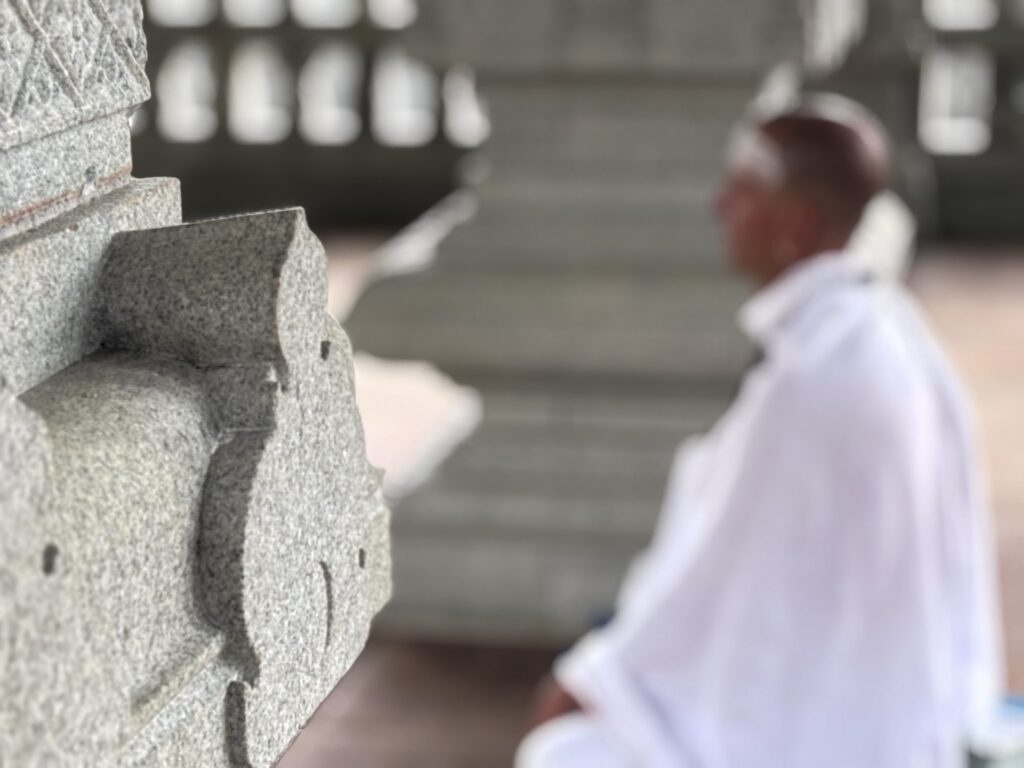
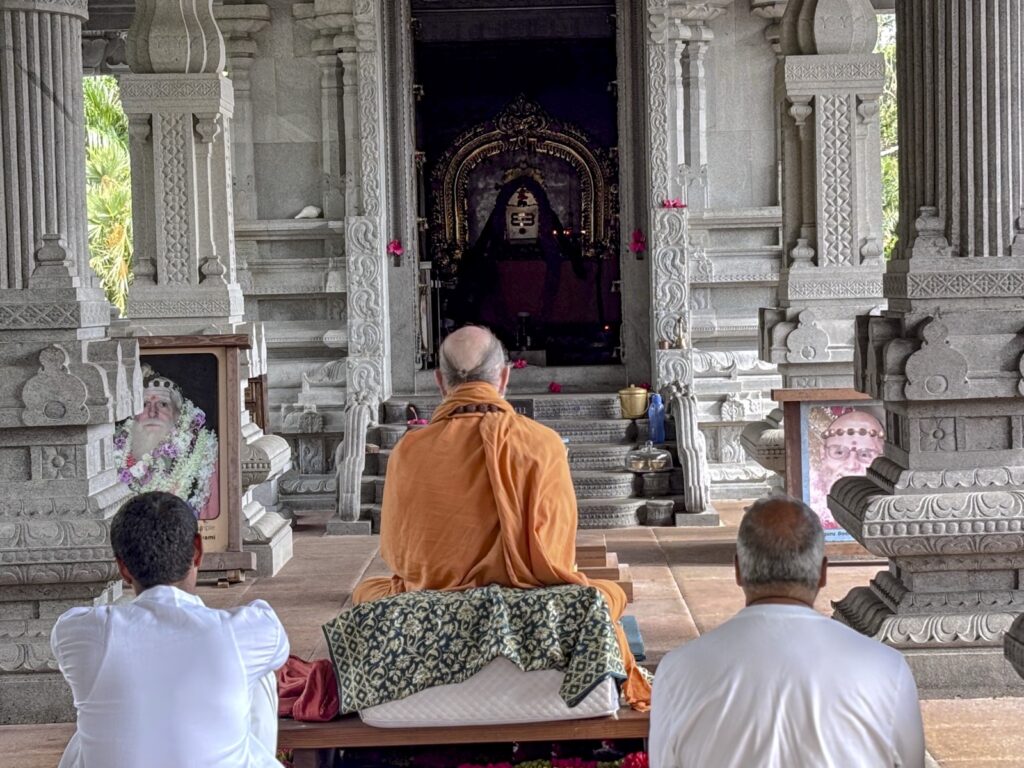
In our monastic order, a monk can only take lifetime vows once they become a sannyasin. Until then they are under short term vows that must be renewed every two years on the auspicious occasion of Guru Purnima. This year our postulants all gathered in the Guru Temple to renew their four vows of humility, purity, obedience and confidence. Below our the introductions to each vow. Also this year, Sadhaka Shankaranatha took his Natyam vows, the next step before eventually becoming a Yogi Tapasvin.

HUMILITY IS THE STATE OF profound maturity in which the soul, immersed in the depths of understanding and compassion, radiates the qualities of mildness, modesty, reverent obeisance and unpretentiousness. There is an analogy in the Saivite tradition that compares the unfolding soul to wheat. When young and growing, the stalks of wheat stand tall and proud, but when mature their heads bend low under the weight of the grains they yield. Similarly, man is self-assertive, arrogant and vain only in the early stages of his spiritual growth. As he matures and yields the harvest of divine knowledge, he too bends his head. In the Tamil language this absence of pride or self-assertion is known as pannivu. Pannivu also means “jewel.” In the Tirukural it is said that “Humility and pleasant words are the jewels that adorn a man; there are none other.”

PURITY IS THE PRISTINE and natural state of the soul. It is not something which the monastic attains as much as that which he already is, and which becomes evident as the layers of adulterating experience and beclouding conceptions are dissipated. Purity is clarity and clearness in all dimensions of being. It is innocence as opposed to familiarity with the ways of the world. It is for monastics the observance of chastity, called brahmacharya. In Tamil purity is given its fullest expression in the term tirikarannasutti, which means “purity in mind, speech and body.” These three–also called thought, word and deed–convey the fullness of the ideal of purity.

OBEDIENCE IS THE STATE OF willingness and cooperation in which the soul remains open and amenable to enlightened direction. For the monastic it is an unbroken pledge of trust in and surrender to the satguru, the guru parampara and the mystic process of spiritual evolution. In the Tamil language this definition of obedience is expressed in the term taalvu enum tanmai, which denotes “the quality or state of humble submission.” Obedience does not consist in blind submission and yielding to authority, nor in weakening our own will that it may be dominated by the will of another. Yet it is, in another sense, submission to a sacred purpose and the divine authority of the Second and Third Worlds. It is, for the monastic, an inner quality that allows him to remain consciously tractable and responsive.

CONFIDENCE IS THE STATE of trust in which the sacred teachings and sensitive or personal matters are not divulged to others. Spiritual matters must be protected and preserved by those to whom they are entrusted, never wantonly or indiscriminately revealed. When we confide in another, we do so with the assurance that sensitive and serious information will not be inappropriately disclosed. In the Tamil language confidence is known as rahasiyam, meaning “secret or mystery.” Confidence as applied to these Sacred Vows does not mean “certainty,” “a belief in one’s abilities” or “self-confidence.” Rather it is a confiding, a trusting and a relying upon. It is the controlled sharing of privileged teachings or information that should not be disclosed, but held in confidentiality. In its most simple form it is the keeping of a secret. Confidence for the monastic may be defined as wisdom in handling information.

Sacred Vows Rekindled Read More »

Guru Purnima 2026

Jai Satguru Bodhinatha Veylanswami!

Guru Purnima was observed at the Aadheenam early this morning with a beautiful pilgrimage to Iraivan Temple, where monks, devotees and guests gathered to honor Satguru Bodhinatha Veylanswami and the unbroken lineage of the Guru Parampara.

At 6:00 a.m., Satguru’s chariot led the procession down Siva Saalai to the temple. Upon reaching Iraivan, Pravinkumar greeted Satguru with an arati before everyone entered the temple for a sacred pada puja. The ceremony was performed by Sannyasin Mayilnathaswami and Sivanadiyar Arinien as Satguru sat in deep meditation. At its conclusion, Satguru blessed everyone with vibhuti, bringing the morning’s observances to a peaceful and inspiring close.

Aum Namah Sivaya.

Guru Purnima 2026 Read More »

Russia Reaches for Yoga’s Peak

Our team in Moscow just sent photos of the shipment of Path to Siva in Russian language they received from the printer. After years of translation and layout, they published 500 copies.


We also received in the same email the PDF of the April/May/June copy of Hinduism Today in Russian language. They have been producing a Russian edition of every issue of the magazine since 2017! An amazing accomplishment which no other team in the world has been able to equal. For those not familiar with their work, they have also published the entire trilogy, Loving Ganesha, Saivite Hinduism for children and more.

Our palms are pressed together to acknowledge their consistent work, all the more amazing as they have kept our high production standards for all the books and the magazine.

Russia Reaches for Yoga’s Peak Read More »

The Path of Egoity, Part Two

Satguru Bodhinatha Veylanswami gives his weekly upadesha in Kadavul Temple at Kauai’s Hindu Monastery in Hawaii. It is part of a series of talks elaborating on the inspired teachings of Satguru Śivaya Subramuniyaswami as found in his book Merging With Śiva.

Television is a window into the āṇava mārga. We see extremely successful professional people who maybe have started on the āṇava mārga and have bypassed it to the artful acting portrayal of people on the āṇava mārga. We can see in their eyes, they have a life that is seeking and searching, understanding and knowing, and their magnetism keeps them before the public year after year after year. These are the professionals. Then we see on TV the āṇava mārgīs by the dozens. They come and go, are hired and not rehired. ¶Before the āṇava mārga, there is only confusion, unqualified thoughts, desires that are only motivative or directional, not crystallized into any kind of a concept that can be manifested toward a fulfillment. The confusion arises out of the drive for self preservation. All animal instincts are alive in such a human being. He does not hold to promises, does not seek to strive, is a proverbial burden on society. Society is made up of āṇava mārgīs and those who live in the other mārgas. Deception, theft, murder, anger, jealousy and fear are often the occupation and the emotions of those living without a personal identity, a well-defined ego.

The Path of Egoity, Part Two Read More »

Clips from Guru Purnima 2026

A short video created by Rajkumar Manickam

Clips from Guru Purnima 2026 Read More »

Scroll to Top